
Social science and history is dedicated to provide good and complete notes of each lesson and question answer according to CBSE new pattern. It also provide worksheet, practice papers,question with answers, map practice etc.which will be very helpful for students. Thanks


Showing posts with label HISTORY-VII. Show all posts

Monday, 25 August 2025

CLASS VII SOCIAL SCIENCE NEW TEXTBOOK ALL QUIZS

Class VII social science New Text BOOK MCQs
CLASS VII NEW TEXT BOOK MCQs

CLASS VII SOCIAL SCIENCE NEW TEXT BOOK MCQs

LESSON 3 : CLIMATE OF INDIA
LESSON 4 : NEW BEGINNINGS – CITIES AND STATES
LESSON 5: THE RISE OF EMPIRES
LESSON 6 : THE AGE OF REORGANISATION
LESSON 7 The Gupta Era: An Age of Tireless Creativity
LESSON 8 HOW THE LAND BECOMES SACRED

Friday, 13 May 2022

HISTORY (VII)-LESSON-7 TRIBES, NOMADS AND SETTLED COMMUNITIES (LESSON NOTES)


HISTORY (VII)-LESSON-7

TRIBES, NOMADS AND SETTLED COMMUNITIES

(LESSON NOTES)

____________________________________________________________

v INTRODUCTION: -

  Ø During the Medieval Age, several social, economic and political development took place.

  Ø But social change was not the same everywhere, because different kinds of societies evolved differently.

  Ø As we known that the Indian society was divided on the basis varnas.  

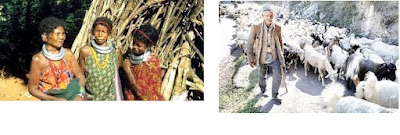
v TRIBAL SOCIETIES

  Ø The communities which did not follow rules and rituals laid down by the Brahmins and nor divided into unequal classes. They were known as tribes.

  Ø Most of the tribes were dependant on agriculture. Others were herders or hunter-gatherers or nomadic.


Wednesday, 11 May 2022

HISTORY (VII)-LESSON-6 TOWNS, TRADERS AND CRAFTSPERSONS (LESSON NOTES)


HISTORY (VII)-LESSON-6

TOWNS, TRADERS AND CRAFTSPERSONS

(LESSON NOTES)

__________________________________________________________

v INTRODUCTION: -

Ø Growth of urbanisation was the main features from 17th century onward. In medieval India, there were three types of towns—a temple town, an administrative town and a commercial town or a port town.

Ø Many outsiders as the Arabs, Turkish and Afghans settled in many parts of the country leading to the evolution of towns and cities.

v TYPES OF TOWNS

Ø ADMINISTRATIVE TOWNS OR COURT TOWNS

§  Some of the important court towns were Lahore, Agra, Fatehpur Sikri and Delhi, Thanjavur.

§  They were centres of administration.

§  Fatehpur Sikri was the new capital founded by Akbar.

§  Delhi was known as Shahjahanabad and was built by Shah Jahan in 1639.

Ø PORT AND TRADING TOWNS

§  Some towns developed as ports due to their proximity to the seashore.

§  Some major ports were Cambay, Surat, Broach, Masulipatanam, Nagapattinam, etc.

Ø TEMPLE TOWNS AND PILGRIMAGE CENTRES

§  Temples towns were important centres of urbanization and led to the development of cities, economy and society.

§  Pilgrims gave huge donations to temples. This wealth was used by temple authorities to finance their trade and banking.

§  Important temple towns were Bhillasvamin in Madhya Pradesh, Somnath in Gujarat, Kanchipuram and Madurai, Tirupati in Andhra Pradesh. Khwaja Muinuddin Chishti, Sufi saint in Ajmer.

v THANJAVUR-COMBINED FEATURES

Ø Thanjavur, in Tamilnadu which was the capital of the Cholas a thousand years ago, emerged as an administrative centre as well as a temple town.

Ø The perennial river Kaveri flows near this beautiful town.

Ø The famous Rajarajeshvara temple built by King Rajarja Chola lies here.


Ø Here, Kings held courts in the mandapas where issuing orders to their subordinates and armies.

Friday, 11 June 2021

HISTORY (VII)- LESSON-4 THE MUGHAL EMPIRE (QUESTION ANSWERS)

HISTORY (VII)- LESSON-4

THE MUGHAL EMPIRE

(QUESTION ANSWERS)

__________________________________________________________________________

(NCERT EXERCISE)

1. Match the following:

1.    mansab

A.   Marwar

2.    Mongol

B.   governor

3.    Sisodiya

C.    Uzbeg

4.    Rathor

D.   Mewar

5.    Nur Jahan

E.    rank

6.    subadar

F.    Jahangir

Answer: 1-E, 2-C, 3-D, 4-A, 5-F, 6-B

2. Fill in the blanks:

(a) The capital of Mirza Hakim, Akbar’s half-brother, was ____________.

(b) The five Deccan Sultanates were Berar, Khandesh, Ahmadnagar, ____________ and _________________.

(c) If zat determined a mansabdar’s rank and salary, sawar indicated his ____________ .

(d) Abul Fazl, Akbar’s friend and counsellor, helped him frame the idea of ____________ so that he could govern a society composed of many religions, cultures and castes.

Answer: (a) Kabul. (b) Bijapur and Golconda. (c) cavalrymen. (d) sulh-i-kul 

3. What were the central provinces under the control of the Mughals?

Answer: The central provinces under the control of the Mughals were Delhi, Kabul, Mewar, Sindh, Marwar, Gujarat, Bengal, Bihar, Orissa, Chittor and Deccan.

4. What was the relationship between the mansabdar and the jagir?

Answer: Mansabdars received their salaries as revenue assignments called jagirs which were somewhat like iqtas. The Mansabdars did not actually reside in or administer their jagirs, rather they only had the rights to the revenue of their assignments, which was collected for them by their servants while the mansabdars themselves served in some other part of the country.

Monday, 24 May 2021

HISTORY (VII)- LESSON-3 THE DELHI SULTANS (QUESTION ANSWERS)

 HISTORY (VII)- LESSON-3

THE DELHI SULTANS

(QUESTION ANSWERS)

__________________________________________________________________________

(NCERT EXERCISE)

1. Which ruler first established his or her capital at Delhi?

Answer: Ananga Pala (Tomaras) of the Rajput Dynasty first established his capital at Delhi.

2. What was the language of administration under the Delhi Sultans?

Answer: The language of administration under the Delhi Sultans was Persian.

3. In whose reign did the Sultanate reach its farthest extent?

Answer: During the reign of Muhammad Tughluq, the Sultanate reached its farthest extent and had marched across a large part of the subcontinent. They defeated the rival armies and seized several cities. The Sultanate also collected taxes from the peasantry and dispensed justice in its realm.

4. From which country did Ibn Battuta travel to India?

Answer: Ibn Battuta was a fourteenth-century travellers who came to India from Morocco, Africa.

Thursday, 6 May 2021

HISTORY (VII)- LESSON-2 NEW KINGS AND KINDOMS (QUESTION ANSWERS)


HISTORY (VII)- LESSON-2

NEW KINGS AND KINDOMS

(QUESTION ANSWERS)

_______________________________________________________________________                                                           (NCERT EXERCISE)

1. Match the following:
Gwjara-Pratiharas    –      Western Deccan
Rashtrakutas             –       Bengal
Palos                           –     Gujarat and Rajasthan
Cholas                         –        Tamil Nadu


Answer: 
Gurj ara-Pratiharas        –   Gujarat and Rajasthan
Rashtrakutas                   –   Western Deccan
Palas                                 –    Bengal
Cholas                               –   Tamil Nadu

2. Who were the parties involved in the ‘tripartite struggle’?
Answer: The parties involved in the tripartite struggle were Gurjar-Pratihara, Rashtrakuta, and Pala dynasties.

3. What were the qualifications necessary to become a member of a committee of the sabha in the Chola Empire?
Answer: The working of a sabha according to the Uttaramerur inscription is given below:

     1.  All those who wish to become members of the sabha should be owners of the land from which land, revenue is collected.

     2.    They should have their own homes.

      3.    They should be between 35 and 70 years of age.

      4.    They should have knowledge of the Vedas.

      5.    They should be well-versed in administrative matters and honest in all dealings.

       6.    If anyone has been a member of any committee in the last three years, he cannot become a member of another committee.

       7.    Anyone who has not submitted his accounts, as well as those of his relatives, cannot contest the elections.

Thursday, 29 April 2021

HISTORY (VII)- LESSON-1 TRACING CHANGES THROUGH A THOUSAND YEARS (QUESTION ANSWERS)


HISTORY (VII)- LESSON-1

TRACING CHANGES THROUGH A THOUSAND YEARS

(QUESTION ANSWERS)

_______________________________________________________________________

NCERT EXERCISE

1. Who was considered a “foreigner” in the past?

Answer: According to the medieval period, any stranger who did not belong to a certain society or culture and was not a part of that particular village was regarded as a foreigner. For example, a city-dweller, therefore, might have regarded a forest-dweller as a foreigner.

2. State whether true or false:

(a) We do not find inscriptions for the period after 700.

(b) The Marathas asserted their political importance during this period.

(c) Forest-dwellers were sometimes pushed out of their lands with the spread of agricultural settlements.

(d) Sultan Ghiyasuddin Balban controlled Assam, Manipur and Kashmir.

Answer:

(a) False

(b) True

(c) True

(d) False

Friday, 25 September 2020

HISTORY(VII)-LESSON-5 RULERS AND BUILDINGS (LESSON NOTES)


HISTORY(VII)-LESSON-5

RULERS AND BUILDINGS

(LESSON NOTES)

________________________________________________________

v INTRODUCTION

Ø In medieval period rulers-built buildings for two purposes as

§  Personal use- forts, palaces, garden residences and tombs etc.

§  Public buildings temples, mosques, tanks, wells, caravanserais and bazaars etc.

Ø They used different architecture techniques in the construction of these buildings. These building showed their engineering skill and technology and grand prestige. This lesson focus on some building constructed in the medieval period.

v QUTB MINAR

Ø Qutab Minar is the highest minar of India with 72.5 meters, height at Mehaurli in Delhi.

Ø It has five stories. The first floor was constructed by Qutbuddin Aybak in 1199 and the rest by Iltutmish around 1229.


Friday, 21 August 2020

HISTORY (VII) LESSON- 4 THE MUGHAL EMPIRE (LESSON NOTES)

HISTORY (VII) LESSON- 4

THE MUGHAL EMPIRE

(LESSON NOTES)

____________________________________________________

v INTRODUCTION

Ø On 15 August our prime minister unfurled the flag and addresses the nation from Red Fort, Delhi. It shows the importance of Red fort. It was built by Mughal ruler Shahjahan. For a long year India was ruled from Red fort. In this lesson we will read about Mughals, rulers, their administration policies, military campaign etc.


Wednesday, 5 August 2020

HISTORY (VII)-LESSON-3 THE DELHI SULTANS (LESSON NOTES)


HISTORY (VII)-LESSON-3

THE DELHI SULTANS

(LESSON NOTES)

__________________________________________________________

v INTRODUCTION

Ø Delhi became an important city only in the twelfth century. Firstly, It become a capital of kingdom under the Tomara Rajputs, who were defeated by Chauhan (also called Chahamanas) of Ajmer. It was inhabited by many Jaina merchants who also constructed a number of temples.

Ø The transformation of Delhi into a capital that controlled a vast area of the subcontinent started with the foundation of the Delhi Sultanate at the beginning of the 13th century.

v THE DELHI SULTANATE

Ø From 13th century onward Delhi become an important city and capital under five different dynasties of Delhi sultans which together known as Delhi sultanate. They established many cities in Delhi as Dehli-i Kuhna, Siri Tughluqabad, Adalibad, Firaz shah kotla, Firuzabad,and Jahanpanah, etc.

DYNASTIES OF DELHI SULTANATE

Monday, 27 April 2020

HISTORY (VII)- LESSON- 2 NEW KINGS AND KINGDOMS (LESSON NOTES)


HISTORY (VII)- LESSON- 2
NEW KINGS AND KINGDOMS
(LESSON NOTES)
_________________________________________________________

v INTRODUCTION

Ø Many ruling dynasties emerged in different parts of the subcontinent between the seventh and twelfth centuries. This lessons focus on some dynasties. We also see their administration system.
DYNASTIES
AREAS
DYNASTIES
AREAS
Gurjara-Pratiharas
MP, RAJASTHAN
Gangas
ODISHA
Rashtrakutas,
MAHARASHTRA
Utkals
ODISHA
Palas
BENGAL
CHERAS
KERALA
Chahamanas (Chauhans).
RAJASTHAN
Cholas
N TAMILNADU
Parmars-
MP
Chera
S TAMILNADU
Chandells
UP


v THE EMERGENCE OF NEW DYNASTIES
Ø By the 7th century, there were big landlords or warrior chiefs (Samantas) in different regions of the subcontinent.
Ø Samantas were expected to bring gifts for their kings or overlords and provide them with military support.
Ø When Samanata became powerful they assumed titles as Maha-samanta, Mahamandaleshvara etc and consolidate the power and declare them as king and established their dynasties.
v THE EMERGENCE OF RASHTRAKUTAS
Ø Initially Rashtrakutas were subordinate to the Chalukyas of Karnataka.
Ø In the mid-eighth century, Dantidurga, a Rashtrakuta chief overthrew his Chalukya overlord.
Ø He performed a ritual with the help of Brahmanas called hiranya-garbha (literally, the golden womb).
Ø It was the symbolic of the “rebirth” of the Rashtrakutas as a Kshtriyas.
v ADMINISTRATION IN THE KINGDOMS
Ø The kings at apex and adopted big titles like Maharaja-adhiraja, tribhuvana-chakravartin.
Ø The kings shared power with their samanats, and with an association of peasants, traders and Brahmanas.
Ø Resources were obtained from the producers .These resources were used to finance the king’s establishment and construct temples and forts.
Ø Functionaries for collecting revenue were recruited from influential families.
v PRASHASHTIS AND LAND GRANTS
Ø The inscriptions which were written in praise of king was known as prashashti. It tells us how rulers wanted to depict themselves as valiant and victorious warriors. Nagabhata, a Pratihara king prashashti in Gwalior.
COPPER PLATES
Ø The kings often rewarded Brahmanas by grants of land. These were recorded on copper plates, which were given to those who received the land.
v WARFARE FOR WEALTH
Ø Tripartite struggle
§  The struggle among Gurjara-Pratihara, Rashtrakuta and Pala’s dynasties to control over Kannauj was known as tripartite struggle.
Ø Sultan Mahmud of Ghazni
§  He was a well known ruler of Afghanistan who ruled from 997 to 1030 AD. He raided the subcontinent seventeen times between 1000 to1025 AD. His main purpose was to plunder the wealth of India. He looted temples like Somnath, Gujarat. He also have a scholar named Al-Biruni who wrote a book Kitab-I Hind.
Ø Chauhan or chahaman rulers
§  Chauhan, ruler ruled over the region around Delhi and Ajmer.
§  They also have conflict with Chalukyas of Gujarat and the Gahadavalas of western.
§  Prithviraj III was a popular Chauhan ruler who defeated Afghan ruler Ghori in 1191in battle of Tarain but lost to him in second battle in 1192.
v THE CHOLAS-EMERGENCE
Ø Cholas were from a small family of Uraiyur. Intially they wer the subordinate of Pallava kings of Kanchipuram.
Ø In 9th century chief Vijayalaya become independent and built city Thanjavur.
Ø Rajaraja I was considered the most powerful Chola ruler and expanded control over most of these areas.
Ø His son Rajendra I, conquered Sri Lanka and countries of Southeast Asia.
v SPLENDID TEMPLES
Ø Cholas were big temple builders. Two famous temples were in Thanjavur and Gangaikondacholapuram.

Ø These temples were the centres of craft production as priests, garland makers, cooks, sweepers, musicians, dancers, etc lived around them.
Ø Temples were not only places of worship but they were the hub of economic, social and cultural life.
Ø In crafting ,making of  bronze image was the finest in chola temples.

v AGRICULTURE AND IRRIGATION
Ø Agriculture was well developed in Cholas along with various methods of irrigation.
Ø The river Kaveri provides the fertile soil and its channel provides the water facility which was good for rice crops.
Ø The rulers also built many canals, tanks, embankments and wells for irrigation.
v THE ADMINISTRATION OF THE CHOLA EMPIRE
Ø Settlements of peasants called were called as UR became prosperous with the spread of irrigation in agriculture.
Ø The village council and the Nadu performed several administrative functions.
Ø Association of traders known as nagarams also performed administrative functions in the town.
Ø Inscriptions also mention about sabha, an assembly or of prominent Brahmana landholders The Sabha had many committees to look after irrigation works, gardens, temples, etc.
v GLOSSORY
Ø Rulers of  Kadamba Mayurashrman and Gurjara-Pratihara Harichandra, were brahmanas by birth, used their military skills to establish their kingdoms in Karnataka and Rajasthan.
Ø Kalhana’s long poem Rajtarangini in Sanskrit recorded the history of kings who ruled over Kashmir. He usually used a variety of sources, including, inscriptions, documents, eyewitness accounts, and earlier histories, in order to present his accounts.
Ø Samantas: The subordinates of kings or overlords who used to bring gifts for their kings or overlords.
Ø Maha-Samanta or Maha-mandaleshwara: The Samantas who gained power and wealth declared themselves Maha-Mahabaleshwar or Maha-samantas i.e. the great lord of a circle or region.
Ø Maharaja-adhiraja: A high sounding title used for great king, overlord.
Ø Tribhuvan-chakravartin: Lord of the three worlds.
Ø Rent: The part of the product that the producers—the peasants, cattle-keepers, artisans- were compelled to pay to the lords.
Ø Revenue: The tax traders had to pay to their lords.
Ø Sultan: An Arabic term used for the ruler.
Ø Ur: Settlements of peasants.
Ø Brahmadeya: The land given to the Brahmanas as a grant.
Ø Vellanvagai: The land of non-Brahmana peasant proprietors.
Ø Shalabhoga: The land for the maintenance of a school.
Ø Devadana/Tirunamattukkani: The land gifted to temples.
Ø Pallichchhandam: The land donated to Jaina institutions.
Ø Nagarams: Associations of traders.
Ø Sabha: The assembly of Brahmanas.
Ø 985 – Rajaraja I became a great Chola ruler.